
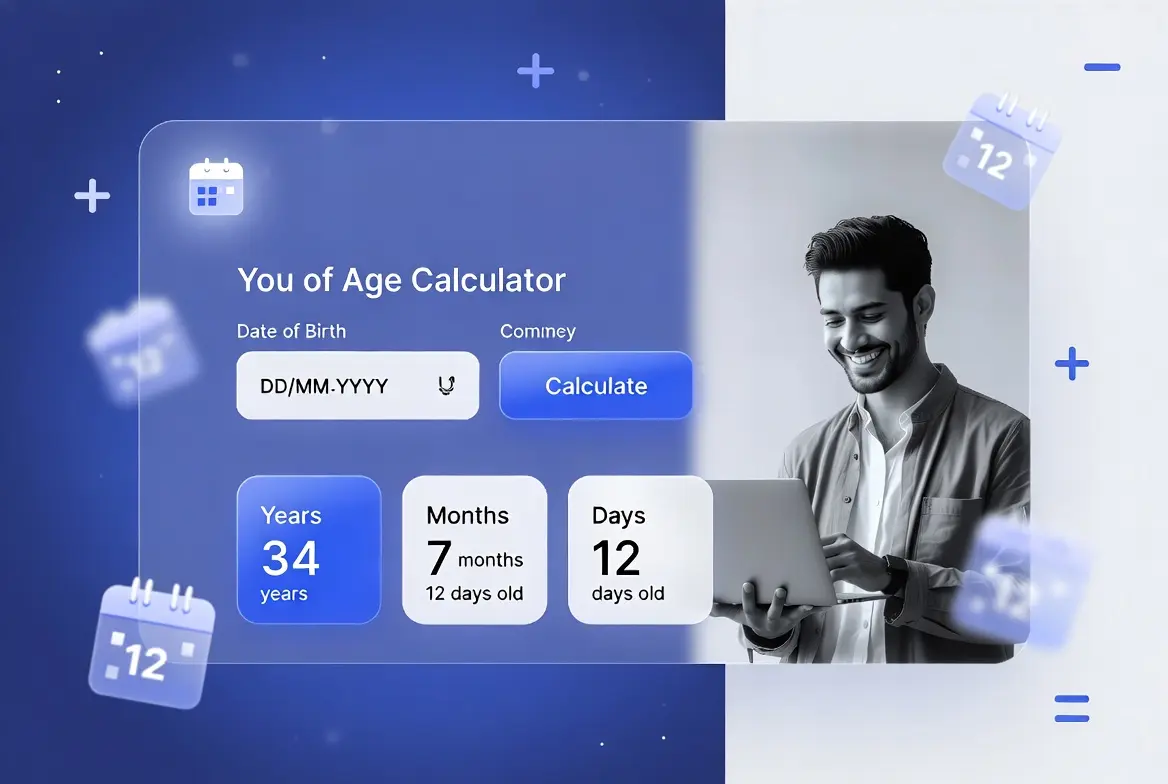
Age Calculator – 100% Free Exact Age Calculator

Free Online Age Calculator – Instant & Accurate
Free Exact Age Tool
Introduction
Knowing your exact age is useful in many situations, from filling out official forms to tracking personal milestones. Our Age Calculator provides an instant and accurate way to determine your age in years, months, and days. Instead of manually counting dates and worrying about leap years, you can obtain reliable results within seconds.
Whether you are calculating age for school admission, employment requirements, insurance applications, retirement planning, or personal curiosity, this online solution offers a fast and user-friendly experience. The tool works directly in your browser, helping users receive precise results without complicated calculations.
What Is an Age Calculator?
An Age Calculator is a digital tool designed to determine the exact time elapsed between a date of birth and the current date. It automatically considers calendar differences, varying month lengths, and leap years to produce an accurate result.
Traditional age calculations often require manual counting, which can become confusing when months and days need to be included. Automated calculations eliminate these challenges and provide dependable results for personal and professional use.
How an Age Calculator Works
An Age Calculator compares the selected birth date with the current date. The system then calculates the difference and presents the result in years, months, and days.
Calculation Process
- Reads the entered date of birth.
- Detects the current calendar date.
- Calculates elapsed years.
- Adjusts months and days accurately.
- Accounts for leap years and month-length variations.
- Displays the final result instantly.
This automated process significantly reduces the chance of human error and ensures consistency across different use cases.
Key Features
The Age Calculator includes several useful features that make it practical for everyday use:
- Instant results
- Years, months, and days breakdown
- Mobile-friendly design
- Simple user interface
- Accurate date handling
- No registration required
- Works on all modern devices
- Completely free access
Benefits
Using an Age Calculator offers numerous benefits compared to manual calculations.
- Saves time.
- Provides reliable results.
- Reduces mathematical mistakes.
- Useful for official documentation.
- Accessible from any location.
- Suitable for all age groups.
The convenience of immediate calculations makes online tools increasingly popular among students, professionals, healthcare providers, and families.
Real-Life Uses
An Age Calculator can be valuable in many real-world scenarios.
Education
Schools and colleges often require exact age verification during admissions.
Employment
Employers may need age confirmation for eligibility requirements and documentation.
Healthcare
Medical professionals frequently use age information when determining treatment plans and dosage recommendations.
Insurance
Insurance policies often depend on age-based calculations and eligibility criteria.
Retirement Planning
Many retirement programs use age milestones to determine qualification periods and benefits.
Personal Milestones
Individuals commonly calculate age for birthdays, anniversaries, and family records.
Step-by-Step Guide
Follow these simple steps to use the Age Calculator effectively:
- Open the tool page.
- Select your date of birth.
- Click the Calculate button.
- Wait for the instant calculation.
- View the result in years, months, and days.
- Use the information wherever needed.
Examples
The Age Calculator can help users understand age differences quickly.
Example 1
Date of Birth: 10 January 2000
Current Date: 30 May 2026
Result: Exact age displayed in years, months, and days.
Example 2
Date of Birth: 15 August 1995
Current Date: 30 May 2026
Result: Automatically calculated without manual counting.
Example 3
Date of Birth: 1 December 2010
Current Date: 30 May 2026
Result: Accurate age breakdown generated instantly.
Advantages Over Manual Calculation
Compared with traditional methods, an Age Calculator provides several important advantages.
- Eliminates calculation mistakes.
- Handles leap years automatically.
- Saves significant time.
- Provides consistent results.
- Works instantly on mobile and desktop devices.
- Requires no mathematical expertise.
Why Accurate Age Information Is Important
Accurate age information is essential in many areas of daily life. Educational institutions, government agencies, healthcare providers, and insurance companies often require precise age details for verification and eligibility purposes. Even a small error in age calculation can lead to incorrect records, delayed applications, or eligibility issues.
For example, school admissions frequently depend on age requirements that must be met by a specific date. Employment opportunities, retirement plans, and government assistance programs may also have age-related criteria. Using a reliable online tool helps ensure that the information provided is accurate and up to date.
Age Calculation for Education and Admissions
Educational institutions often require proof of age during the admission process. Many schools have minimum and maximum age requirements that determine whether a student is eligible to enroll in a specific grade level. Parents frequently need to verify a child's age before submitting applications.
Age Calculation for Healthcare Purposes
In healthcare, age is one of the most important factors used to evaluate medical needs and treatment options. Doctors often consider a patient's age when recommending medications, vaccinations, screenings, and preventive care measures.
Common Mistakes People Make When Calculating Age
One of the most common mistakes people make is calculating age by simply subtracting the birth year from the current year. While this method may provide a rough estimate, it does not account for months and days, which can significantly affect the final result.
Tips for Getting the Most Accurate Results
To achieve the most accurate results, always enter the correct date of birth exactly as it appears on official documents. Double-check the day, month, and year before calculating the result.
Future Importance of Digital Calculation Tools
Digital tools continue to transform the way people perform everyday calculations. Tasks that once required manual effort can now be completed in seconds with greater accuracy and convenience. As technology continues to evolve, online calculators are becoming an essential part of personal and professional workflows.
Frequently Asked Questions (FAQs)
Age Calculator free to use?
Yes. The Age Calculator is completely free to use online without registration or downloads.
Age Calculator accurate for calculating age?
The Age Calculator provides accurate results using real calendar dates, including leap years and different month lengths.
Age Calculator work with future and past dates?
Yes. The Age Calculator can calculate age using both past and future dates based on the date you enter.
Age Calculator calculate years, months, and days?
Yes. The Age Calculator displays the age in years, months, and days for easy understanding.
Age Calculator safe to use online?
Yes. The Age Calculator works directly in your browser and does not require creating an account to use its basic features.
Can I use it on a mobile phone?
Yes. The interface is responsive and works smoothly on smartphones and tablets.
Does the tool store personal information?
No. Calculations are performed directly in the browser and no personal information is required.
Do leap years affect results?
Yes. Leap years are automatically considered to ensure accurate calculations.
Helpful Online Tools
- Percentage Calculator
- EMI Loan Calculator
- BMI Calculator
- Scientific Calculator
- Password Generator
- QR Code Generator
- Barcode Generator
- URL Shortener
Trusted References
- Time and Date
- National Institute of Standards and Technology (NIST)
- Centers for Disease Control and Prevention (CDC)
Conclusion
The Age Calculator is a practical solution for anyone who needs fast and accurate age calculations. With an intuitive interface, precise date handling, mobile compatibility, and instant results, it simplifies a task that would otherwise require manual effort. Whether you need age information for official documents, healthcare records, educational purposes, or personal milestones, this free online tool delivers dependable results in seconds.
Understanding the Mathematics Behind Age Calculation
Age calculation involves more than simple subtraction. The process requires understanding how calendars function, including the varying lengths of months and the occurrence of leap years. A standard year contains 365 days, while a leap year contains 366 days. Leap years occur every four years, with exceptions for years divisible by 100 but not by 400. This complexity makes manual calculation challenging, especially when precision is required down to the exact day.
When calculating age, the system must first determine the number of full years that have passed. Then it calculates the remaining months, taking into account that different months have 28, 29, 30, or 31 days. Finally, the remaining days are counted. This three-tier approach ensures that the result accurately reflects the true elapsed time between two dates. Our Age Calculator automates this entire process, eliminating the possibility of human error.
The mathematical foundation of age calculation relies on date difference algorithms. These algorithms compare the year, month, and day components separately, then adjust for cases where the current day is less than the birth day, or the current month is less than the birth month. This adjustment process is what makes automated tools significantly more reliable than mental arithmetic or simple subtraction methods.
Historical Context of Age Measurement
The concept of measuring age has evolved significantly throughout human history. Ancient civilizations used various methods to track the passage of time, from lunar calendars to solar observations. The Gregorian calendar, which is the most widely used civil calendar today, was introduced in 1582 by Pope Gregory XIII as a reform of the Julian calendar. This reform corrected the drift in the equinoxes and established the modern system of leap years that our Age Calculator uses today.
Before the widespread adoption of standardized calendars, age was often estimated based on seasonal changes, agricultural cycles, or significant local events. The development of accurate timekeeping and calendar systems allowed for more precise age documentation, which became increasingly important for legal, medical, and administrative purposes. Today, digital tools have taken this precision to the next level, providing instant calculations that would have required considerable effort in previous eras.
The standardization of birth registration in the nineteenth and twentieth centuries further emphasized the importance of accurate age records. Governments began requiring official documentation of births, which included exact dates. This practice created the foundation for modern age verification systems used in education, employment, healthcare, and legal contexts. Our online Age Calculator builds upon this historical framework, offering a modern solution to an age-old need.
Age Calculation in Different Cultures
Different cultures around the world have unique approaches to age calculation. In many Western countries, age is calculated based on the Gregorian calendar, with a person becoming one year older on their birthday. However, in some East Asian cultures, traditional age counting systems differ. For example, in South Korea, a person is considered one year old at birth, and everyone gains a year on New Year's Day rather than on their individual birthday. This cultural difference can lead to a discrepancy of one or two years between traditional Korean age and international age.
In China, the traditional lunar calendar is still used for certain cultural and religious purposes, including the calculation of zodiac signs and auspicious dates. The lunar calendar operates on a different cycle than the solar-based Gregorian calendar, with months beginning on the new moon. This means that a person's lunar birthday may fall on a different Gregorian date each year. Our Age Calculator uses the standard Gregorian system, which is the internationally recognized method for official age documentation.
Understanding these cultural variations is important in our increasingly globalized world. When dealing with international documentation, immigration processes, or cross-cultural communication, it is essential to clarify which age calculation system is being used. Our tool provides the standard international age, which is widely accepted for official purposes across most countries and institutions.
The Role of Age in Legal and Government Systems
Age plays a critical role in legal systems worldwide. Most countries establish specific age thresholds for rights and responsibilities, including voting, driving, drinking alcohol, entering contracts, and criminal liability. These age-based laws require accurate age verification, making tools like our Age Calculator valuable for preliminary assessments. While official documentation is always required for legal purposes, online calculators can help individuals understand their current age status in relation to these thresholds.
Government benefit programs frequently use age as a determining factor for eligibility. Social security systems, pension plans, and retirement benefits typically have age-based qualification requirements. Understanding exactly when one reaches these milestones can help with financial planning and timely application submission. Our Age Calculator provides the precise age breakdown needed to track progress toward these important life stages.
In criminal justice systems, age determines whether an individual is tried as a juvenile or an adult. The transition between these categories has significant legal implications, affecting sentencing, rehabilitation options, and record sealing. Accurate age documentation is therefore essential in legal proceedings. While our calculator is not a substitute for official records, it demonstrates the precision required in age-related legal matters.
Age and Health Screenings
Medical professionals use age as a primary factor in determining appropriate health screenings and preventive care schedules. Different screenings are recommended at specific ages, from childhood vaccinations to adult cancer screenings. For example, mammograms are typically recommended starting at age forty, while colonoscopies are generally suggested beginning at age forty-five. Knowing one's exact age helps individuals stay on schedule with these important health measures.
Pediatric care is particularly age-sensitive, with growth charts, developmental milestones, and vaccination schedules all tied to precise age calculations. A difference of even a few months can affect whether a child is meeting expected developmental benchmarks. Parents and healthcare providers rely on accurate age information to ensure children receive appropriate care at the right times. Our Age Calculator can assist parents in quickly determining their child's exact age for medical appointments and record-keeping.
As the population ages, geriatric care also depends heavily on accurate age information. Certain medications have age-related dosage guidelines, and treatment plans may be adjusted based on a patient's age group. Elderly patients may require different approaches to surgery, medication, and therapy compared to younger adults. Precise age calculation supports better healthcare outcomes across all life stages.
Age Requirements in Sports and Competitions
Competitive sports often have strict age categories to ensure fair competition and safety. Youth leagues, amateur tournaments, and professional organizations all use age verification to place participants in appropriate divisions. Age fraud, where athletes misrepresent their age to gain competitive advantages, has been a concern in various sports. Accurate age calculation and verification systems help maintain the integrity of competitive sports at all levels.
In Olympic and international competitions, athletes must meet specific age requirements. Some sports have minimum age limits to protect young athletes from physical and psychological stress, while masters categories have minimum age requirements for older competitors. Coaches, parents, and athletes themselves need reliable age information to determine eligibility for different competitive levels and events.
School sports programs also depend on age verification. Eligibility rules often require students to be within certain age ranges to participate in specific grade-level competitions. Our Age Calculator can help parents, coaches, and administrators quickly verify that participants meet age requirements, supporting fair and organized athletic programs.
Digital Security and Age Verification Online
In the digital age, age verification has become increasingly important for online safety. Many websites and platforms require users to confirm their age before accessing age-restricted content. Social media platforms, gaming sites, and streaming services all implement age verification measures to comply with regulations and protect minors. While our Age Calculator is a general-purpose tool, it illustrates the precision needed in digital age verification systems.
Online retailers selling age-restricted products, such as alcohol, tobacco, or certain medications, must verify customer age before completing transactions. These verification systems often cross-reference provided information with official databases. The accuracy of age calculation in these systems directly impacts legal compliance and consumer protection. Understanding how age is calculated and verified helps consumers navigate these digital requirements more effectively.
Parental control features on devices and platforms also rely on age information. Parents can set age-appropriate content filters and usage limits based on their children's ages. As children grow, these settings need regular updates. Our Age Calculator can help parents quickly determine when their child reaches age thresholds that require adjustments to digital access permissions and content filters.
Financial Planning and Age Milestones
Age is a fundamental factor in personal financial planning. From opening a bank account to qualifying for senior discounts, age determines access to various financial products and benefits. Retirement planning, in particular, requires precise age tracking. Individuals need to know exactly when they reach ages that trigger pension eligibility, social security benefits, or required minimum distributions from retirement accounts.
Insurance premiums are often age-based, with rates changing at specific age thresholds. Life insurance, health insurance, and auto insurance all consider age when determining coverage options and costs. Understanding one's exact age helps individuals anticipate these changes and make informed decisions about coverage adjustments. Our Age Calculator provides the precise age information needed for these financial calculations.
Investment strategies also vary by age. Younger investors typically have longer time horizons and can afford more aggressive portfolios, while older investors often shift toward conservative investments as they approach retirement. Financial advisors use age as a starting point for recommending appropriate asset allocations. Accurate age information supports better investment decisions and long-term financial security.
How to Verify Age for Official Documents
When applying for official documents such as passports, driver's licenses, or national identification cards, accurate age verification is essential. Applicants must provide birth certificates or other official documentation that clearly states their date of birth. Government agencies then use this information to verify age eligibility for the requested document. Our Age Calculator can help applicants confirm their current age before beginning the application process.
In cases where official birth records are unavailable or disputed, alternative documentation may be required. School records, medical records, baptismal certificates, and census records can sometimes serve as supplementary evidence of age. The process of establishing age in these situations can be complex and may require legal assistance. Having a clear understanding of one's age based on available information is the first step in navigating these challenges.
For immigrants and refugees, age verification can be particularly challenging when official records from their country of origin are incomplete or unavailable. International organizations and host countries develop protocols for estimating age when documentation is lacking. These situations highlight the importance of accurate age records and the challenges that arise when such records are not maintained.
Technology and the Future of Age Calculation
As technology continues to advance, age calculation and verification methods are becoming more sophisticated. Biometric systems can now estimate age based on physical characteristics, though these methods are not yet as accurate as document-based verification. Artificial intelligence and machine learning are being applied to improve age estimation from images and videos, with applications in security, marketing, and healthcare.
Blockchain technology is being explored as a way to create immutable age verification records. Digital identity systems built on blockchain could provide secure, verifiable age information that cannot be tampered with. These innovations may eventually complement or replace traditional document-based age verification, offering greater security and convenience for both individuals and institutions.
Wearable technology and health monitoring devices are also incorporating age-related data. Fitness trackers and smartwatches use age as a factor in calculating heart rate zones, calorie burn, and activity recommendations. As these devices become more integrated with healthcare systems, accurate age information will play an increasingly important role in personalized health monitoring and preventive care.
Common Questions About Age Calculation Methods
Many people wonder about the best method for calculating age in different contexts. For most everyday purposes, calculating age in completed years is sufficient. This means a person is considered a certain age only after they have completed that full year of life. However, some contexts, such as medical dosing or developmental assessments, may require more precise age calculations that include months and days.
Another common question concerns the treatment of leap year birthdays. Individuals born on February 29th technically have a birthday that occurs only once every four years. In non-leap years, these individuals typically celebrate on February 28th or March 1st, depending on local customs and legal conventions. Our Age Calculator handles leap year dates accurately, ensuring that individuals with February 29th birthdays receive correct age calculations in all years.
Time zone differences can also affect age calculation in certain contexts. A person born near midnight may technically have a different birth date depending on the time zone used for the calculation. For most purposes, the date of birth as recorded on official documents is used, regardless of time zone considerations. Our calculator uses the standard date-based approach, which is appropriate for virtually all practical applications.
Practical Tips for Using Age Calculators Effectively
To get the most out of any age calculation tool, always double-check the date of birth you enter. A single digit error in the day, month, or year can produce significantly incorrect results. When entering dates, pay attention to the format used by the tool. Some systems use month-day-year format, while others use day-month-year format. Our Age Calculator uses a standard date picker interface to minimize format-related errors.
Consider the purpose of your age calculation when interpreting results. If you need age for legal or official purposes, always verify the result against official documentation. For personal curiosity or informal planning, the calculator provides sufficient accuracy. When calculating age for medical purposes, consult with healthcare professionals to ensure the calculation method aligns with clinical requirements.
Bookmark reliable age calculation tools for quick access. Having a trusted calculator readily available saves time when you need to verify age for various purposes. Our free online Age Calculator requires no registration and works across all devices, making it a convenient choice for regular use. The tool's accuracy and ease of use make it suitable for both one-time calculations and frequent reference.
Understanding Age-Related Terminology
Various terms are used to describe different age groups and life stages. Infancy typically refers to the first year of life, while toddlerhood covers ages one to three. Childhood extends from age three through puberty, which usually begins around age twelve. Adolescence spans the teenage years, and adulthood begins at age eighteen in most legal systems. Middle age is generally considered to begin around forty, while senior or elderly status typically begins around sixty-five.
Generational labels also categorize people by birth year ranges. Baby boomers were born between 1946 and 1964, Generation X between 1965 and 1980, millennials between 1981 and 1996, and Generation Z between 1997 and 2012. These generational categories are used in marketing, sociology, and workforce planning. Understanding where one falls within these categories provides context beyond simple numerical age.
In demographic and statistical contexts, age is often grouped into categories for analysis. Common groupings include five-year or ten-year ranges. These categories are used in census data, health statistics, and market research. While our Age Calculator provides exact age, understanding how age is categorized in different contexts helps users apply the information appropriately.
Age Calculation for Genealogy and Family History
Genealogists and family historians frequently need to calculate ages from historical records. Census records, baptismal registers, marriage licenses, and death certificates often contain dates that require age calculation. These historical documents may use different calendar systems or date formats, adding complexity to the calculation process. Understanding the historical context of record-keeping practices helps ensure accurate age reconstruction.
When working with incomplete historical records, genealogists sometimes need to estimate ages based on available information. A child's age might be inferred from school records, while an adult's age might be estimated from marriage or military service records. These estimates are always noted as approximations, with the understanding that exact ages may not be recoverable from the available documentation.
Modern genealogy software often includes built-in age calculation features that handle calendar conversions and date format variations. These tools help family historians maintain accurate records and identify potential errors in their research. Our online Age Calculator can supplement these specialized tools, providing quick verification of age calculations during the research process.
Environmental and Lifestyle Factors That Affect Age Perception
While chronological age is fixed and measurable, biological age can vary based on lifestyle and environmental factors. Diet, exercise, stress levels, sleep quality, and exposure to toxins all influence how the body ages. Some individuals may have a biological age that is significantly younger or older than their chronological age. This distinction is important in healthcare, where biological age may be more relevant than chronological age for certain assessments.
Research in epigenetics has revealed that lifestyle choices can affect gene expression related to aging. These epigenetic changes can be measured through biological markers, providing insights into an individual's biological age. While our Age Calculator provides chronological age, understanding the difference between chronological and biological age helps individuals make informed decisions about their health and lifestyle.
Psychological age, or how old a person feels, is another subjective measure that differs from chronological age. Some people feel younger than their years, while others may feel older due to health conditions or life experiences. This subjective age can influence behavior, social interactions, and self-perception. While not measurable by a calculator, psychological age is an important aspect of the human experience of aging.