
EMI Calculator Work Out Your Monthly Loan Payment
Enter the loan amount, interest rate, and tenure to see your monthly installment and total interest instantly.
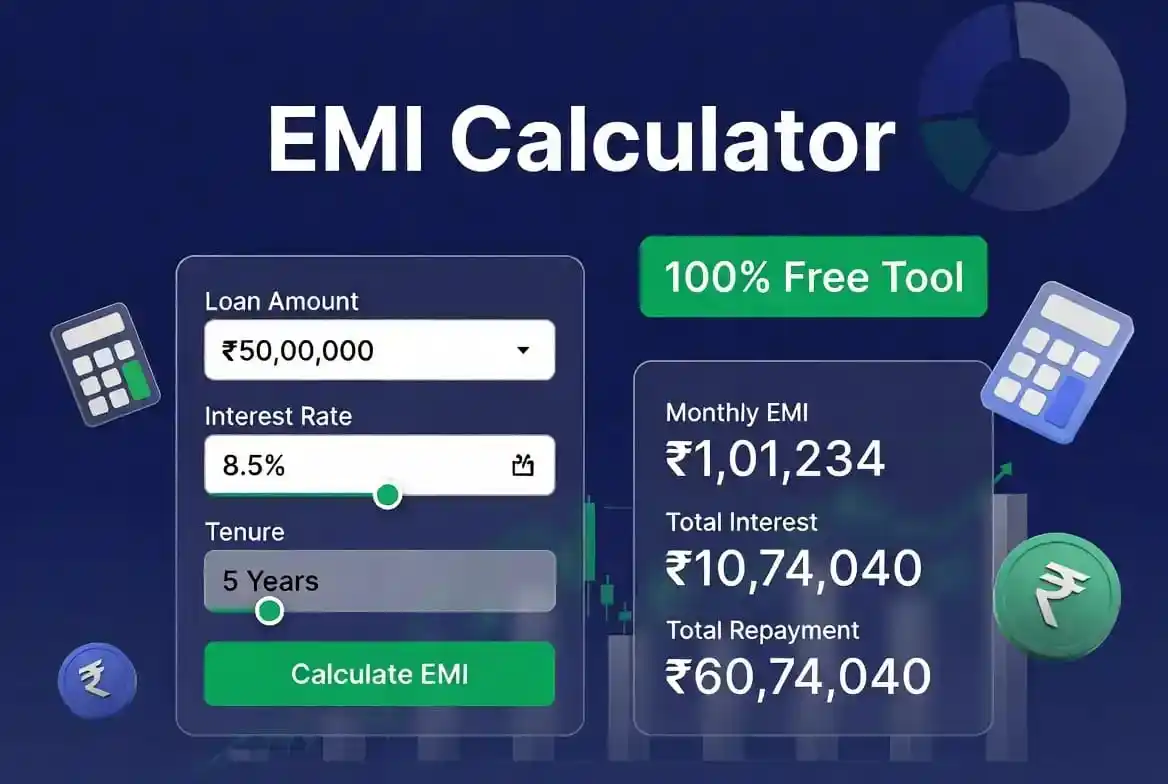
What This EMI Calculator Does
An EMI Calculator works out your fixed monthly loan payment before you sign anything. EMI stands for Equated Monthly Installment, the same amount you pay each month toward a loan, made up of a portion going toward interest and a portion going toward the principal you actually borrowed.
Early in a loan, most of each payment goes toward interest. Later on, more of it goes toward the principal itself. Seeing that split before you commit to a loan is the main problem this tool solves.
The Consumer Financial Protection Bureau has a clear explanation of how amortization affects a loan if you want the background on why payments are structured this way.
How the Calculation Works
The formula behind this EMI Calculator is standard across lenders: EMI equals principal multiplied by the monthly interest rate multiplied by (1 plus the monthly rate) raised to the number of months, divided by that same term minus 1.
You don’t need to work through that by hand. Enter the loan amount, the annual interest rate, and the tenure in years, and the tool runs the calculation instantly.
Reducing Balance vs. Flat Rate Interest in an EMI Calculator
This calculator, like nearly every bank and lender, uses the reducing balance method: interest is charged only on whatever principal is still outstanding, so the interest portion shrinks every month as the balance goes down.
A small number of lenders, particularly for short-term personal loans in some markets, instead advertise a flat rate, where interest is calculated on the original principal for the entire term, even though you’ve been paying it down.
A flat rate that sounds lower on paper can work out to a meaningfully higher real cost than a reducing balance loan at the same headline percentage, so it’s worth asking a lender directly which method they use before comparing two offers side by side.
Why Check This Before Applying for a Loan
The biggest benefit is seeing past marketing language to the actual number you’ll pay each month. A lender’s pitch can make a loan sound more affordable than it is; running your own numbers cuts through that.
It also makes comparison easy. You can see exactly how much a 0.5 percent difference in interest rate changes your monthly payment, which is useful leverage when negotiating with a bank or loan officer.
As a general guideline, financial advisors often suggest keeping total monthly loan payments under 40 percent of take-home pay. The CFPB’s guide to the debt-to-income ratio explains how lenders themselves use a similar benchmark to decide whether to approve an application in the first place.
What This EMI Calculator Doesn’t Account For
This tool gives you the core monthly figure based on principal, rate, and tenure, but a real loan offer usually includes a few extra costs it can’t see. Processing or origination fees, often one to two percent of the loan amount, are typically charged upfront and aren’t part of the EMI itself.
Mortgage loans frequently require property insurance or mortgage insurance, which adds to your real monthly outlay without changing the EMI figure shown here. Ask your lender for the full breakdown, sometimes called the annual percentage rate or APR, which is designed to fold fees into a single comparable number.
It also assumes the interest rate stays exactly as entered for the full tenure. For a fixed-rate loan that’s accurate by definition, but for a floating or variable-rate loan, your real payment will change whenever the lender’s reference rate moves, even though this calculator shows one fixed number for the life of the loan.
Who This EMI Calculator Is For
Anyone about to take on a mortgage, a car loan, a personal loan, or business financing benefits from running the numbers first. A mortgage is usually the largest financial commitment most people make, and going into one without knowing the real monthly cost is a genuine risk.
The same logic applies to a small business loan, where every dollar spent on interest is a dollar not going toward growth.
Step-by-Step Guide
- Work out your actual loan amount, meaning the total cost minus any down payment.
- Check the current interest rate offered by the lender you’re considering.
- Pick a realistic tenure. A longer tenure lowers the monthly payment but increases total interest paid over the life of the loan.
- Enter all three figures above and check the result.
- Try a couple of different tenures side by side to see how much the total interest figure actually changes.
EMI Calculator Worked Examples
A 20,000 dollar car loan at 8 percent over 5 years works out to a monthly payment of roughly 405 dollars, with about 4,300 dollars paid in interest over the full term.
Stretch that same loan to 7 years and the monthly payment drops to around 312 dollars, but total interest rises to over 6,200 dollars. A lower monthly payment doesn’t necessarily mean a better deal.
On a 250,000 dollar mortgage at 6.5 percent over 30 years, total interest paid over the life of the loan often exceeds the original amount borrowed. Paying a modest amount extra each month can cut years off the loan and save tens of thousands in interest, which is exactly the kind of comparison this tool makes easy to see.
Should You Pay Down a Loan Early?
If you come into extra money, a bonus or an inheritance, it’s worth comparing what paying down the loan saves you against what that money could earn elsewhere.
Run the numbers with a lump sum applied to the principal and check the “Total Interest” figure. On a high-interest loan, the interest saved often beats what a typical savings account would return.
Another common approach is paying one extra installment a year. On a twenty-year loan, that single habit can shave several years off the total term.
Before you do, check your loan agreement for a prepayment penalty. Some lenders charge a fee for paying off a loan faster than scheduled, which can eat into the interest savings if the loan is still within its penalty window.
Common EMI Calculator Mistakes
The most frequent error is entering the wrong unit. This EMI Calculator expects the interest rate as an annual percentage and the tenure in years, so a lender quoting a monthly rate of 1 percent needs to be entered as 12, and a loan of 18 months should be entered as 1.5 years.
Mixing these up can make a payment look either wildly cheap or impossibly expensive, so if a result surprises you, check the units first.
The second mistake is comparing loans on the EMI alone. A lower payment usually comes from a longer tenure, which quietly raises the total interest you pay. Always read the Total Interest and Total Payment lines beside the monthly figure before deciding which offer is actually cheaper.
A third mistake is forgetting that the amount you enter should be the money you actually borrow, not the price of the item. If you’re buying a 30,000 dollar car with a 5,000 dollar down payment, the principal is 25,000 dollars. Entering the full price overstates every figure on the screen.
Stress Testing a Loan With the EMI Calculator
A good habit is running your loan three times: once at the rate you were quoted, once one percentage point higher, and once two points higher. If you’re considering a floating rate loan, the higher results show what a rate rise could do to your monthly budget.
On a 200,000 dollar loan over 20 years, moving from 7 percent to 9 percent raises the payment by roughly 250 dollars a month.
If that higher payment would strain your income, the loan is riskier than the headline number suggests, and it may be wiser to choose a fixed rate or borrow less.
Comparing Two Loan Offers With the EMI Calculator
To compare offers with this EMI Calculator, run each one through it with the same principal, then add any upfront fees to the Total Payment figure.
Suppose Bank A offers 9 percent with no fee, and Bank B offers 8.6 percent with a two percent processing fee, on a 100,000 dollar loan over 10 years. Bank B’s lower rate saves a little each month, but the 2,000 dollar fee paid on day one cancels out most of that advantage.
If you repay the loan early, Bank B could end up costing more overall. The offer with the lower rate isn’t always the cheaper loan. The honest comparison is the total money paid out, including fees, over the time you expect to keep the loan.
Legitimate Ways to Lower Your EMI
If the EMI on the screen is too high, there are a few real levers. A larger down payment reduces the principal directly, which lowers every other figure. A stronger credit profile can qualify you for a lower rate, and even half a percentage point matters over a long tenure.
Choosing a longer tenure lowers the monthly payment, though it raises total interest, so some borrowers pick a longer tenure for safety and then make voluntary extra payments when their budget allows. Refinancing to a lower rate later is another option, but check that any fees for switching don’t outweigh the savings.
EMI Calculator Special Cases: Zero Interest and Part-Year Terms
This tool requires a rate greater than zero, because the standard formula breaks down at exactly 0 percent. If a seller offers a genuine zero percent loan, the calculation is simply the loan amount divided by the number of months.
For terms that aren’t whole years, enter a decimal: 30 months is 2.5 years, and 9 months is 0.75 years. Using the EMI Calculator this way lets you check short-term store financing and buy-now-pay-later plans, which are often quoted in months rather than years.
Using the EMI Calculator to Judge Whether a Loan Is Expensive
A quick way to use the EMI Calculator to judge a loan is to divide Total Interest by the principal. If you borrow 100,000 and the EMI Calculator shows 50,000 in interest, you are paying fifty cents of interest for every dollar borrowed.
A ratio under about 0.3 is usually considered light for a medium-term loan, while ratios approaching or exceeding 1.0 are common on long mortgages and worth planning around carefully. It won’t replace professional advice, but it turns an abstract percentage into a number you can actually feel.
Fitting the EMI Into Your Monthly Budget
Once the EMI Calculator gives you a monthly figure, test it against your real spending rather than just your income. List rent or existing housing costs, utilities, food, transport, insurance, and any other debt payments, then subtract them from take-home pay.
What remains has to cover the new payment with room to spare. A sensible safety margin is to make sure that even if your income dropped by ten percent, you could still make the payment without touching an emergency fund. If not, reduce the loan amount or lengthen the tenure until the payment fits comfortably.
It also helps to keep three to six months of expenses saved before taking on a large loan. An emergency fund means an unexpected repair or a short gap in income doesn’t turn into a missed payment, which can trigger late fees and damage your credit record.
This EMI Calculator Works on Any Device
This tool is fully responsive, so it works the same whether you’re checking numbers on a phone at a dealership or reviewing a mortgage in detail on a desktop at home.
Frequently Asked Questions
Does this EMI Calculator work for any bank?
Yes. The formula used here is the standard for amortized loans everywhere, whether you’re borrowing from a large bank or a local credit union.
Is it accurate for floating interest rates?
It’s exact for a fixed rate. For a floating rate, you can enter a higher rate to see a worst-case scenario and check whether you could still manage the payments if rates rise.
Can I use this for car loans and personal loans too?
Yes. Enter the relevant principal, rate, and tenure for any loan type, home, car, personal, or business.
Does this save or send my numbers anywhere?
No. The calculation runs in your browser, and nothing you enter is stored or transmitted.
Know the Number Before You Sign
Understanding what a loan will actually cost you each month, and in total, is one of the more useful financial habits available for free. Use this EMI Calculator before applying for a loan, and again whenever your situation changes enough to be worth checking.